
Emotion regulation, affect labeling, and the inner life in Inside Out.
(Disclaimer: The articles provided on this website are for informational and enhancing mental health awareness purposes only. They are not intended to be clinical interventions or provide medical advice. If you have any concerns about your well-being and/or well-being of others, please seek guidance from a qualified professional, such as a physician, psychologist, or counselor. If you are experiencing a clinical emergency please call 911 or 988 or go to the nearest emergency room. Here are some national and international helplines.)
By Dr. Michael Zakalik, Licensed Clinical Psychologist
The Psychology of Inside Out: The Quiet Power of Sadness
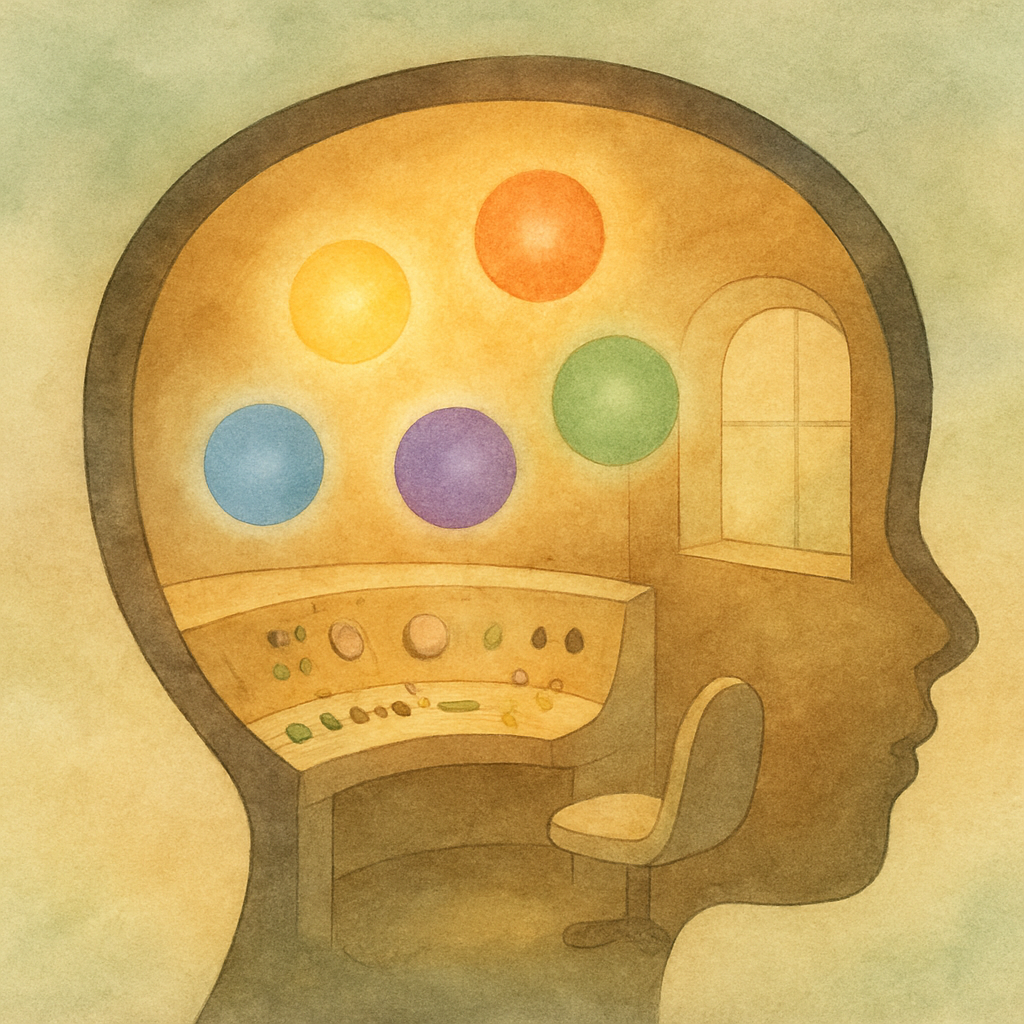
Pixar's Inside Out is, on its surface, the story of an eleven-year-old girl named Riley adjusting to her family's move from Minnesota to San Francisco. Below the surface, however, it is something far more ambitious: an animated primer on the psychology of emotion, narrated by the emotions themselves. Joy, Sadness, Fear, Anger, and Disgust inhabit a control center inside Riley's mind, each taking turns at the console as they guide her through the world.
The film was developed in close consultation with affective scientists, including Dacher Keltner and Paul Ekman, and the psychological accuracy shows. At the heart of the film is an argument that runs counter to most of what contemporary culture teaches us about feelings: that sadness is not a problem to be solved but a messenger to be welcomed.
A Brief History of Basic Emotions
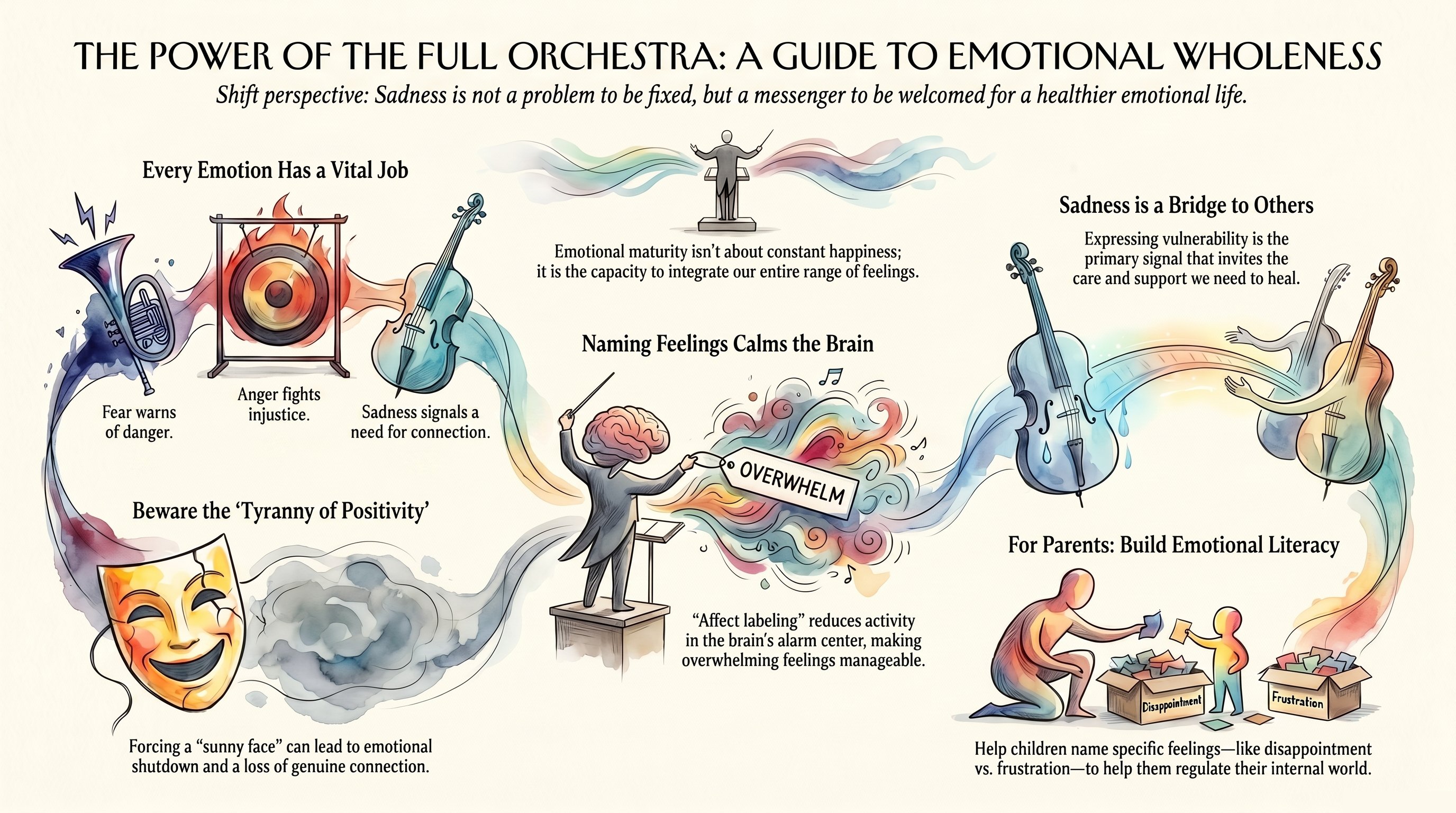
The film's premise draws from decades of research on what psychologists call basic or primary emotions. Paul Ekman identified a small set of emotions that appear across cultures and seem to have evolved to serve specific adaptive functions: happiness, sadness, fear, anger, disgust, and surprise. Inside Out uses five of these, leaving out surprise because the filmmakers felt it overlapped too much with fear. Each emotion, in evolutionary terms, exists because it solved a problem. Fear warns of danger. Anger mobilizes us against injustice. Disgust protects us from contamination. Joy reinforces what helps us flourish. Sadness, perhaps the most misunderstood, signals that something important has been lost, slows us down for reflection, and invites care and connection.
The Tyranny of Positivity
The film's central tension emerges from Joy's well-intentioned but ultimately harmful belief that her job is to keep Riley happy at all times. She draws a chalk circle and asks Sadness to stay inside it. This is a precise illustration of what psychologists call experiential avoidance, the attempt to escape or suppress unwanted internal experiences, one of the most reliable predictors of psychological suffering. The more we try not to feel what we feel, the more those feelings intensify or surface in disguised forms. The researcher Susan David calls this the tyranny of positivity, the demand that we present a sunny face regardless of our actual experience, and its cost is often a deepening of the very unhappiness it was meant to cure.
When Joy Fails
As Riley struggles with the move, Joy works harder and harder to maintain her happiness, refusing to let Sadness touch Riley's core memories. This escalating effort, not Sadness herself, is what eventually breaks the system. What follows is a surprisingly accurate depiction of emotional shutdown. Riley loses her capacity to feel joy and genuine sadness alike, which in clinical terms is a hallmark of depression. Depression is often described as extreme sadness, but clinically it more often resembles a flatness in which neither joy nor sorrow can reach the person. In the absence of Joy and Sadness, Riley becomes reactive and disconnected. She is not feeling too much. She is feeling too little of the right things.
The Revelation About Sadness
The film's emotional climax hinges on a flashback. Riley, heartbroken after missing a shot in a hockey game, sits alone under a tree. Joy remembers only what came next: her parents and teammates gathering to lift her up. Sadness sees it differently. She points out that Riley's parents came to her because Riley cried. Her sadness was the signal that drew others to her side.
"Sadness is not the opposite of joy. It is, in many ways, its precondition. The capacity to grieve loss is what makes connection possible."
Joy realizes she has misunderstood her own role. Well-being requires the full range of emotional experience. Without Sadness, Joy becomes brittle, performative, and ultimately empty.
Affect Labeling and the Power of Naming
The personification of the emotions maps onto a clinical technique called affect labeling, the simple but powerful act of naming what we feel. Research by Matthew Lieberman shows that affect labeling reduces activity in the amygdala and increases activity in the prefrontal cortex, which helps with regulation. Putting feelings into words calms the nervous system. This is why therapists ask, simply, what are you feeling right now. Naming an emotion creates a small but essential distance between us and the feeling. For children especially, giving them the language of feeling, distinguishing frustration from disappointment, is one of the foundations of emotional development. Inside Out hands its audience that vocabulary.
Core Memories and the Architecture of Identity
The film's core memories fuel the islands of personality that make Riley who she is. When her core memories are disrupted, the islands begin to fall. This is an elegant metaphor for how identity works: our sense of who we are is woven from remembered experiences, relationships, values, and roles, and major life events can genuinely cause parts of it to collapse. The answer, delivered in the final act, is that identity must become more complex. The single-emotion memories of early childhood are replaced by multi-colored memories that hold both joy and sadness. Riley emerges more integrated than before.
Developmental Transitions and Emotional Complexity
Riley's crisis is not incidentally timed. She is eleven, on the threshold of adolescence, when the limbic system matures before the prefrontal cortex, producing a period of emotional intensity that can look like instability. The film ends with a glimpse of an upgraded console and a button labeled puberty. The capacity to tolerate and integrate complex emotions is a lifelong task, and adolescence is its first acute phase. The sequel, Inside Out 2, expands this by introducing Anxiety, Envy, Embarrassment, and Ennui, but the original remains the foundation.
Reflections for the Viewer
Inside Out has become, for many families and clinicians, a shared vocabulary for emotional experience. Children can point to a feeling and name it. Parents can use the characters as conversation starters. For adults, the film is an invitation to reexamine our own relationship with emotion. Many of us were raised to suppress sadness and perform happiness, to treat difficult feelings as problems to manage rather than messengers to hear. The feelings we exile do not disappear. They wait, often growing larger, until the system can no longer hold. The film's final image is not pure happiness. It is wholeness: the capacity to hold joy and sadness at once, and to trust that a full life requires the full orchestra.
Try this: Watch it together. After the movie, ask your child which emotion was driving their console today, and share which one was driving yours. Naming the feeling, exactly as the film does, is the first small step to managing it.
Frequently asked questions
Is Inside Out psychologically accurate?
Remarkably so. It was developed with affective scientists Dacher Keltner and Paul Ekman, and its treatment of basic emotions, naming feelings, and emotional suppression closely tracks the research.
What is the main psychological message of Inside Out?
That every emotion, even sadness, has a purpose. Trying to feel only happiness backfires. Emotional health comes from welcoming the full range of feelings.
Why is Sadness so important in the movie?
Sadness signals loss, slows us down to reflect, and draws others to us for connection. The film shows that sadness is often what makes joy and closeness possible.
Is Inside Out good for kids?
Yes. It gives children a shared vocabulary for their feelings, which supports emotional literacy and makes hard emotions easier to talk about. If your child shows signs of anxiety, a shared language for feelings can make those conversations easier to start.
Enjoyed this? Explore more articles