
(Disclaimer: The articles provided on this website are for informational and enhancing mental health awareness purposes only. They are not intended to be clinical interventions or provide medical advice. If you have any concerns about your well-being and/or well-being of others, please seek guidance from a qualified professional, such as a physician, psychologist, or counselor. If you are experiencing a clinical emergency please call 911 or 988 or go to the nearest emergency room. Here are some national and international helplines.)
By Dr. Michael Zakalik, Licensed Clinical Psychologist
How to Stop Toddler Tantrums: A Psychologist's Calm-Down Guide
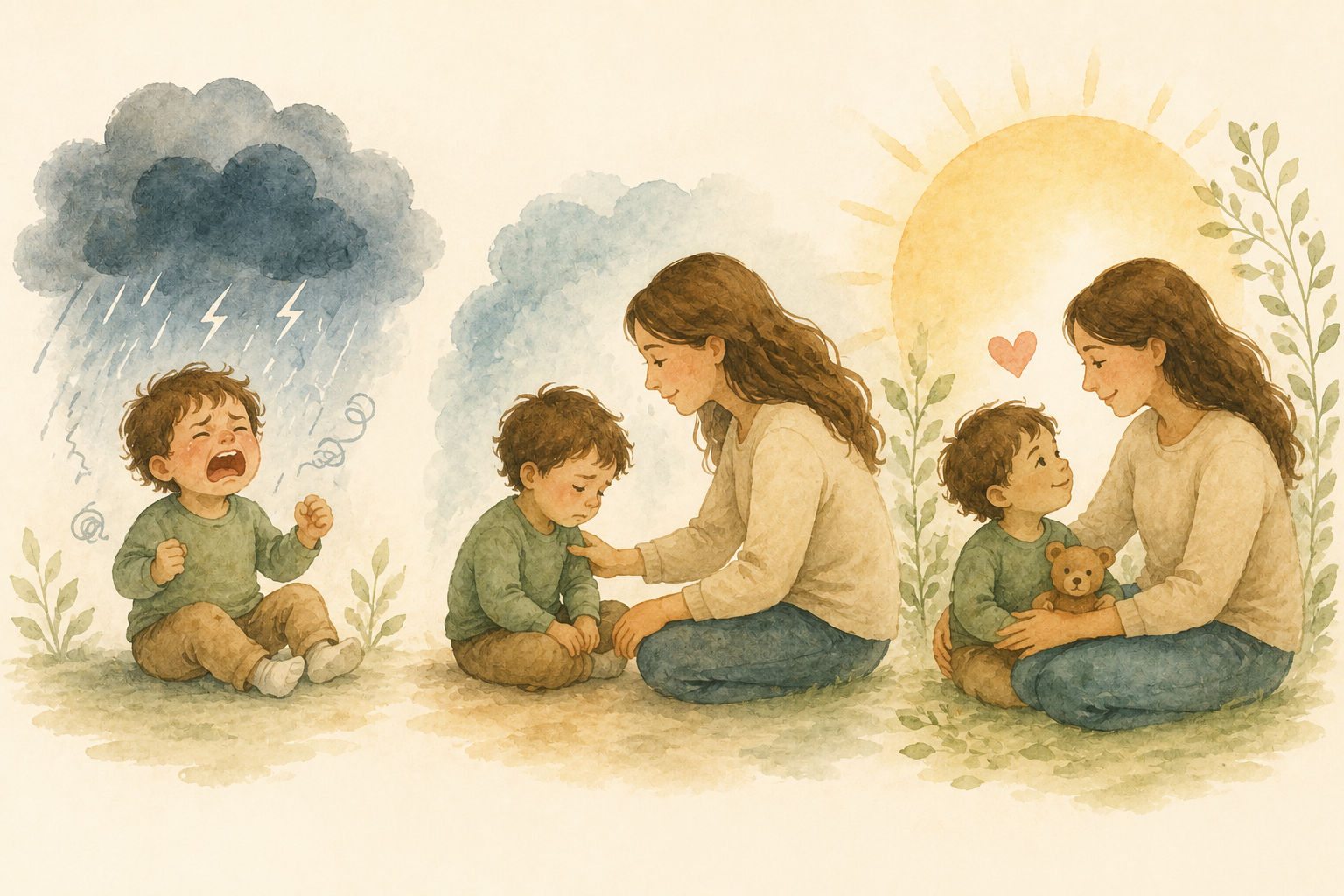
When your toddler melts down in the cereal aisle, it can feel like a battle of wills. It is not. A tantrum is not your child giving you a hard time. It is your child having a hard time, in a brain that has not built the brakes yet. The quickest way to stop a tantrum is to help your child's body feel safe and calm first, and to save the teaching for after the storm has passed. Connection comes before correction, every single time.
Why toddlers have tantrums (it is not bad behavior)
The thinking part of the brain, the part that manages impulses and big feelings, is still very much under construction in a toddler. When a feeling gets too big, it floods the system and the alarm brain takes over. Add tired, hungry, overstimulated, or simply unable to find the words, and you get a tantrum. It is not defiance and it is not a sign you are doing something wrong. A tantrum is a storm passing through a small body that does not yet have an umbrella.
Tantrum or meltdown? Why it matters
A tantrum often has a goal, like wanting the toy, and it can ease when your child feels heard or the situation shifts. A meltdown is a full nervous-system overload with no goal, and pushing harder only makes it worse. Both call for the same first response in the moment: calm, not consequences.
What to do in the moment: calm the storm
- Steady yourself first. Your calm is your child's thermostat. Take one slow breath before you respond.
- Get low and get close. Drop to their level and soften your face and voice. Safety before words.
- Name the feeling, not the behavior. "You are so mad the screen went off. That is really hard." Feeling understood is what lowers the alarm.
- Hold the limit with warmth. You can accept the feeling and still keep the boundary: "I won't let you hit. I am right here with you."
- Wait it out. Big feelings need to crest and fall. Fewer words, more presence.
"A tantrum is not your child giving you a hard time. It is your child having a hard time."
After the storm: this is when you teach
The teachable moment is not during the meltdown, it is after, once calm returns and the thinking brain is back online. Reconnect first, then briefly name what happened and a better next step: "Next time you can tell me, I am frustrated." That is where the learning actually sticks.
How to prevent tantrums before they start
You will never prevent every tantrum, and you should not try to. But you can lower the odds. Protect sleep and snacks, since hungry and tired are tantrum fuel. Offer small choices to meet your child's need for control, like "red cup or blue cup." Narrate transitions and give warnings, like "two more minutes, then we clean up." And practice feelings language in calm moments, so the words are there when the storm hits.
Try this: Next meltdown, do just three things. Get low. Name the feeling. Hold the limit. Skip the lecture entirely, and notice how much faster the storm passes.
When to seek extra support
Tantrums are a normal part of early childhood. But if they are extreme, still frequent and intense well past age four or five, involve aggression that hurts, or are steadily wearing your family down, it can help to talk with a psychologist. Reaching out is not a sign that something has gone wrong. It is simply a faster way to calmer days.
Frequently asked questions
At what age do tantrums peak?
Most often between about 18 months and 3 years, when big feelings have arrived but language and the thinking brain are still catching up. They tend to ease as those skills grow.
Should I just ignore a tantrum?
Ignore the behavior if it is purely playing to an audience, but never ignore the child. Stay nearby and calm. Your steady presence is what helps the storm pass.
Are time-outs the answer?
Time-outs can stop a moment but teach very little. A calm time-in, where your child settles beside you, usually does more to build real emotional control.
Why does my child have tantrums only with me?
Because you are their safe person. Many children hold it together at daycare and let it all out where it feels safest, which is with you. It is a backhanded compliment.
Enjoyed this? Explore more articles